Friday, October 26, 2012

Tuesday, September 18, 2012
Nearly Fall in the Garden
Things are winding down in the garden.

I'm always amused when movies or TV shows indicate that garden harvest(s) take place all at once and must be done in a day or two. Perhaps some fruits have such a narrow window, but MY garden has harvesting being done all the time.
I finally stopped picking the pole beans - I'm letting them dry. The
dry beans will soon be ready to shell...I can't wait to try my own
home-grown kidney beans in chili! I need to find a better way of trellising beans for next year.

The onion harvest was very disappointing:

But, as though to make up for it, the butternut squash harvest is going to be phenomenal!

I've picked three watermelons to date - one nearly grocery-store-size! Found three more in the garden last night without really looking hard.

Three more roma tomatoes were plucked from the vine last night...nearly ripe. Plenty of unripe ones remain...maybe they'll ripen before frost? I'm not going to hold my breath, but it'll be too bad if the don't, for these are WONDERFUL 'maters. They might be Grandma Mary's paste tomatoes, or they might be Amish Paste...I just don't remember which of the vines was the one that survived!

The scarlet runner beans are still blooming in quiet profusion. I never eat these...the pods are a bit to fuzzy for my taste. They might be less fuzzy as very young beans, but this year I might try some of the dried beans...along with the other dry beans I'm intentionally growing.

So...if I don't eat them, then why do I plant them, especially in the quantity that I do? Because they are great for attracting pollinators, and the hummingbirds like them, too.
Soon it will be time to dig the spuds...see if any actually survived the CPB onslaught. And the garlic needs to be planted for 2013.
Bee Deaths linked to GMOs
| Stop the Mass Death of Bees!
Tell EPA and USDA to ban Bayer's insecticides & Monsanto's GMOs! |
|||||
| |||

Monsanto's Mon810 corn, genetically engineered to produce a synthetic version of the insecticide Bt, has been banned in Poland following protests by beekeepers who showed the corn was killing honeybees. Meanwhile, commercial beekeepers in the U.S. have filed an emergency legal petition with the Environmental Protection Agency (EPA) to suspend use of a pesticide that is linked to massive honey bee deaths. The legal petition, which specifies Bayer's neonicotinoid pesticide clothianidin, is backed by over one million citizen petition signatures.
Poland is the first country to formally acknowledge the link between Monsanto's genetically engineered corn and the Colony Collapse Disorder (CCD) that's been devastating bees around the world, but it's likely that Monsanto has known the danger their GMOs posed to bees all along. The biotech giant recently purchased a CCD research firm, Beeologics, that government agencies, including the US Department of Agriculture, have been relying on for help unraveling the mystery behind the disappearance of the bees.
Now that it's owned by Monsanto, it's very unlikely that Beeologics will investigate the links, but genetically engineered crops have been implicated in CCD for years now.
In one German study, when bees were released in a genetically engineered canola field, then fed the canola pollen to younger bees, scientists discovered the bacteria in the guts of the young bees took on the traits of the canola's modified genes. That proves that GMO DNA in pollen can be transferred to bees though their digestive system.
Many bee-keepers have turned to high-fructose corn syrup to feed their bees. High-fructose corn syrup is made from Monsanto's genetically engineered corn and that corn is treated with Bayer's neonicotinoid insecticides.
Bee colonies began disappearing in the U.S. one year after the EPA allowed these new insecticides on the market in 2004-2005. Even the EPA itself admits that "pesticide poisoning" is contributing to bee colony collapse.
One of the observed effects of these insecticides is weakening of the bee's immune system. Forager bees bring pesticide-laden pollen back to the hive, where it's consumed by all of the bees. Six months later, their immune systems fail, and they fall prey to natural bee infections, such as parasites, mites, viruses, fungi and bacteria. Indeed, pathogens such as Varroa mites, Nosema, fungal and bacterial infections, and IAPV are found in large amounts in honey bee hives on the verge of collapse.
Three recent studies implicate neonicotinoid insecticides, or "neonics" for short, which coat 142 million acres of corn, wheat, soy and cotton seeds in the U.S. alone. They are also a common ingredient in a wide variety of home gardening products. As detailed in an article published by Reuters, neonics are absorbed by the plants' vascular system and contaminate the pollen and nectar that bees encounter on their rounds. Neonics are a nerve poison that disorient their insect victims and appear to damage the homing ability of bees, which may help to account for their mysterious failure to make it back to the hive.
This was the conclusion of research which came out in the prestigious Journal Science. In another study, conducted by entomologists at Purdue University, the scientists found that neonic-containing dust released into the air at planting time had "lethal effects compatible with colony losses phenomena observed by beekeepers." A third study by the Harvard School of Public Health actually re-created colony collapse disorder in several honeybee hives simply by administering small doses of a popular neonic, imidacloprid.
Learn How to Protect Your Neighborhood Bees:
http://www.honeybeehaven.org/
[This article is from www.organicconsumers.org]
Tuesday, August 14, 2012
A Bit o' Rain
At last! Thursday last week we woke to rain...and it rained for three whole days! I got about an inch and a half out at the house, although just a few miles north of me they had over three inches! Still, I'll take it. It started off as a heavy rain - so heavy, in fact, that when I drove thru Napoleon on the way to work Thursday morning, there was a lake in front of the gas station and a whirlpool circling the drain in the road (in truth, some of this might have simply been the result of ground too hard from drought to soak up the rain as it fell). By late morning, however, it had let up, and for the next two days it was mostly misting - light rain that could soak in.

I picked more corn - and more beans. That's what's producing right now.

I was very excited to find one blue kernel on one of the ears of Painted Hills.

Watermelons are growing on the vines - how does one know when they are ready to pick, though? And if the squash beetles leave 'em alone, I should have lots of butternut squash this fall.
The spuds have tried to rally - they are sending out some new leaves, but with them are coming a new batch of CPBs. Grrr. I may have to give up potatoes. :(
Thursday, August 2, 2012
Better than Peas
The silks were brown, so I figured it was time to harvest some of the corn. Oh, my goodness - just look at 'em! That's Painted Hills on the left, Ambrosia in the middle and the two on the right are Fleet.

First, there was some disappointment. Below is what the Painted Hills, an heirloom variety, is supposed to look like. Its claim to fame is its beautifully multi-colored kernels. Mine were all just white. Hm. Did they send me the wrong seed? Nope - what I planted was multi-colored. Could it be the poor soil here affected the coloration? I have no idea, but I was disappointed. (Reading thru the description on the FEDCO website, they say the ears have mostly white kernels, with other colors interspersed. Maybe some of the other ears will be more colorful.)

Painted Hills Sweet Corn | Photo credit: we'moon in the woods, Flickr, Creative Commons,
via Frugal-Cafe Blog Zone
Still, I cooked 'em all up and while watching the final episode of the first season of Torchwood, I enjoyed the best corn I've ever grown. Yum.

The (few) leftovers went into the freezer.
Wednesday, August 1, 2012
Drought and the Garden
The peas have given up the ghost - and who can blame them in the heat and drought we've had this summer! I'd almost give up on the beans as well, which seemed to be producing a few flowers, but no actual beans...until this week. Huzzah - the rattlesnake pole beans have finally started to produce!

But the plants are not thriving. A) The twine I've been using for trellising keeps breaking - I never had this kind of problem back in NY, and b) something is eating the plants. The bush beans (dry beans) have struggled and I don't think I've seen a single blossom there. The culprit? You tell me:
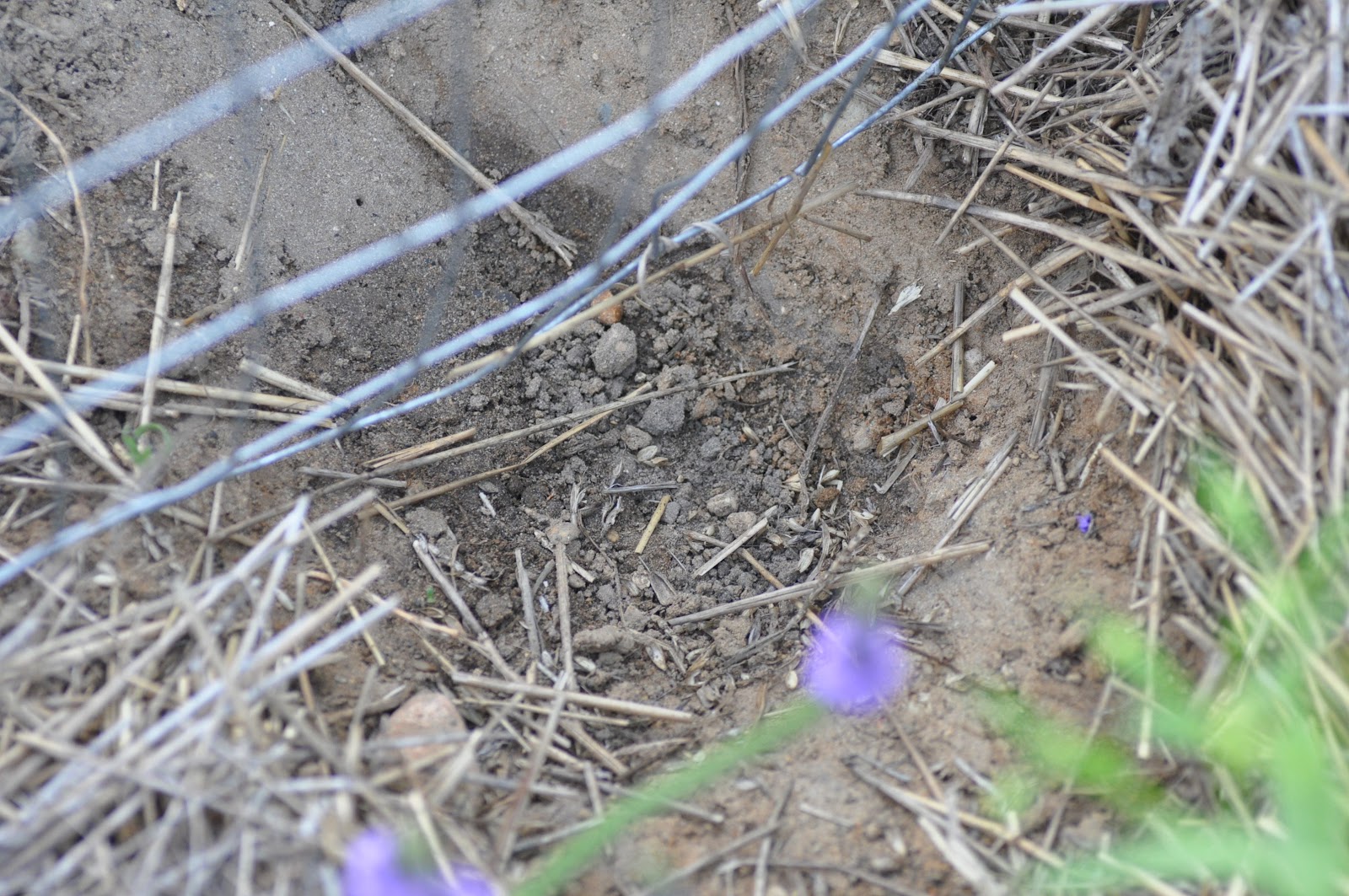
Yes...that's a hole dug under the fence. I found that last night. I've seen rabbits in the garden, and certainly have seen the damage they've done to the beans. I never had rabbit problems in NY. The worst I had was the CPBs and the year the voles (?) ate the carrots.
Now, this hole is suspect belongs to the 13-lined ground squirrel. I've seen one in the yard, and recently found two dead in the road, but otherwise they've been pretty secretive. I don't know if they damage crops or not, but they are definitely living in my raised beds...almost as bad as the moles.

The corn, while crowded, is actually looking pretty good.

In fact, there are quite a number of ears this year, and many of decent size! I'm really looking forward to harvesting these...if I can get them before the raccoons. Based on the crop at the moment, this is the best luck I've ever had with corn!

The butternut squash is going great guns! It got off to a late start, but it seems to be making up for lost time now.

I've also got some watermelons planted in there - and look! A melon is in the works! I'm not the biggest melon fan, but I like the idea of growing them.

Sunday, June 24, 2012
Progress Report
Here it is, the near end of June. While some rain has fallen, most has fallen around my address, not at my address. Things are still quite dry. Still, with carefully applied water from the hose, it looks like we will have some veg to harvest yet.

I think the corn will definitely pass "knee high by the 4th of July" - it sure looks promising. This is actually the best-looking corn I've ever grown!

The assorted pole beans are starting to climb - a good sign.

The carrots...well...I have yet to master carrot-planting. They always come up in clumps. I've had some success transplanting, but it's a tedious chore. Right now I'm working on battling the weeds that are also growing with the carrots.

Peas have been blooming for two or three weeks now, although most of the plants are under two-feet tall! Runty - lack of rain.

Never the less, there are lots of pods filling up! Should be able to start harvesting in a week, I should think.

The paltry few onions are doing well, too - maybe next year I'll try planting seeds again.

The spuds are looking great for the most part...and the CPB apparently think so, too. I must've squished well over a hundred of the beggars the other night, and last night it looked like I hadn't touched a one of them! Must go on a rampage tonight...or I won't have any plants left at all!

Tomatoes? Only two plants remain, and they are struggling.

But the squash and cukes are coming up - so that's a plus.

I have yet to get the sweet potatoes planted...perhaps tonight. And it's time to make another batch of mozzarella!
Subscribe to:
Posts (Atom)